/01DEEP LEARNING / GENOMICS
HelixGuardSEQUENCE → ASSESSMENT
MECHANISM STUDY / 01SCHEMATIC
HelixGuard
From a sequence of bases to a traceable risk assessment. Genomic modeling meets explicit biological constraints and query-linked evidence.
Software, intelligence & a curious mind.
Thoughtfully built. Made to move.
I build across software engineering, machine learning and research—connecting the model, the system behind it, and the person who uses it.
A little about meFrom a sequence of bases to a traceable risk assessment. Genomic modeling meets explicit biological constraints and query-linked evidence.
SEC filings become retrievable evidence. A guarded agent loop combines deterministic financial tools, checked drafts and citations back to the source.
Turn API contracts into tests, inspect generated code before execution, and compare observed behavior across runs. Quality becomes a repeatable gate.
Read process telemetry, locate deviations and constrain recommendations to valid operating phases. An industrial digital twin with explicit rules.
A connected path from resume to preparation to interview feedback. A Java backend carries the workflow across student and company workspaces.
A resume becomes a structured profile. Collected openings become a ranked shortlist, with an authenticated dashboard to track the next move.
Capture the useful corners of the web. Organize and search them locally, protect sensitive collections, and carry your library through explicit backups.
Map an application, queue its checks and connect findings to evidence. Retrieval-assisted explanations come after the observation, where they belong.
An automated path from scattered job feeds to normalized records, skill signals and recurring reports. The deliverable is a workflow that leaves artifacts.
Vessel tracks pass through three different lenses: formal protocol checks, fuzzy risk and relationship graphs. An explainable maritime anomaly simulation.
Listening beneath the rails. A team-built vibration-monitoring prototype connects piezoelectric sensors, edge analysis and a wireless gateway to a remote dashboard.
See the vehicle. Change the beam. A team-built camera and Raspberry Pi prototype turns an oncoming-traffic signal into a physical high-to-low headlight transition.
More work across products, systems and experiments. Open a project for its scope and tools.
Trader archetypes, a price-time limit-order book and network rumor propagation, with experiment replay.
Market simulation
MediaPipe pose landmarks, exercise-phase logic and spoken form feedback, with processing in a browser worker.
Prototype · reliability work remains
Structured extraction, concept graphs, verification and sourced synthesis. A research prototype without clinical efficacy claims.
Research prototype
An explicit complaint lifecycle with native SQL, role-based access, audit history and bounded asynchronous notifications.
Workflow application
An LSTM forecasts signal degradation; fuzzy urgency guides a modeled make-before-break satellite handover.
Research simulation
Capture structured interaction events and screenshot/action pairs, with batching, retry and a local data inspector.
Assessment prototype
WebRTC screen sharing and chat with a React interface and a Node/Express signaling layer.
Communication project
Browser game-state extraction, expert rollouts and a PyTorch DQN explore a hybrid heuristic-and-learning policy.
Local learning experiment
I build systems that connect.
From the model to the interface,
the details belong together.
I’m Shiven Patro, a Computer Science undergraduate at VIT-AP. My work moves between full-stack products, AI systems and research: from healthcare software at Cordly AI to federated learning research at NIT Tiruchirappalli. I like understanding a problem deeply enough to build something useful around it.
My favorite part is the in-between: where a rough idea becomes a working prototype, and a working prototype becomes something you want to spend time with.
Define the inputs, constraints and evidence needed before choosing a model or a framework.
Bring the interface, service and data together. Make a useful vertical slice before adding more moving parts.
Exercise failures, missing evidence and edge cases. A result should come with enough context to assess it.
Improve the experience, document the boundaries, and make the next run easier to reproduce.
Different disciplines. Shared curiosity.
Choose a thread to follow.
Representation learning, retrieval and explicit checks, with evidence that stays connected to the result.
A path through learning, making,
and figuring things out along the way.
The milestones are nice.
What they make possible is better.
Completed CS50x in 2025, with Focus Booster Extension as my final project.
A course credential in computer science, covering problem sets and a final software project.
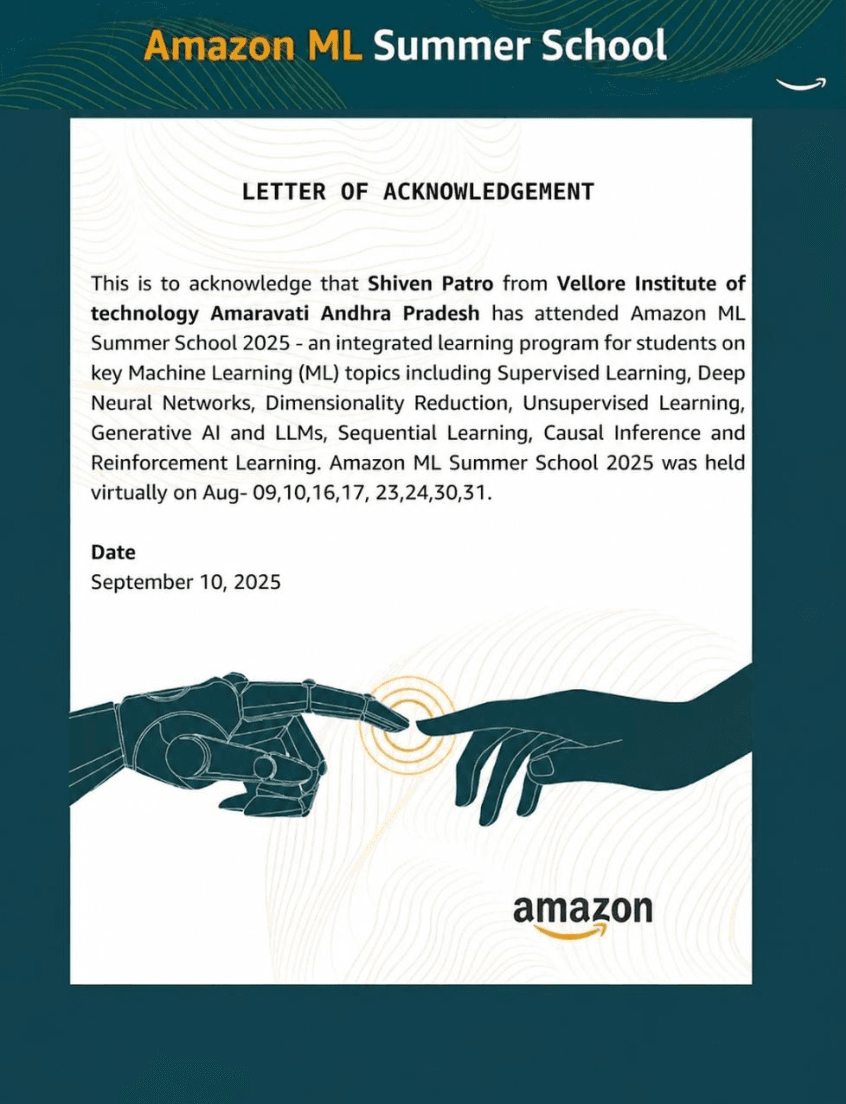
Selected for Amazon’s 2025 ML learning program, spanning deep learning, generative AI and reinforcement learning.
Attended the virtual program across four weekends in August 2025, learning with Amazon scientists. The letter of acknowledgement was issued on 10 September 2025.
Eco-Twin Oracle with team SpicyJalebi, for AVEVA’s Track B at IIT Hyderabad.
A collaborative digital-twin prototype. Round 2 advancement is the recorded milestone; no final placement is claimed.
Top 8 finalist with Team Mechanoids at Coimbatore Institute of Technology’s national hackathon.
Represented VIT-AP at the Qubitron 2025 finals on 15 March 2025. The organizer’s email names Team Mechanoids among the top eight finalist teams; the participation certificate records the event and date.
No brief. No right answer.
Just curiosity, followed somewhere.
A research internship exploring drug–target interaction prediction: from a central coordinator to peer-based learning and failure-aware synchronization.
Explore the research pageWhen medical imaging data is scarce, what does the quantum component contribute to a learning system? A question of inductive bias, explored through a twin-architecture benchmark.
Isolating Quantum Inductive Bias: A Twin-Architecture Benchmark for Data-Scarce Medical Imaging. TQCEBT 2026. IEEE Xplore: https://ieeexplore.ieee.org/document/11681822
Ideas in progress.
A few things worth putting into words.
Lessons from taking a student project’s backend into the real world of hosting constraints.
A student developer’s perspective on open tools and the people building them.
The shared habit behind training and building: show up, practice, and keep going.
A project, a collaboration, or a beautifully
half-formed idea. I’d love to hear it.